
The 60-Second Answer
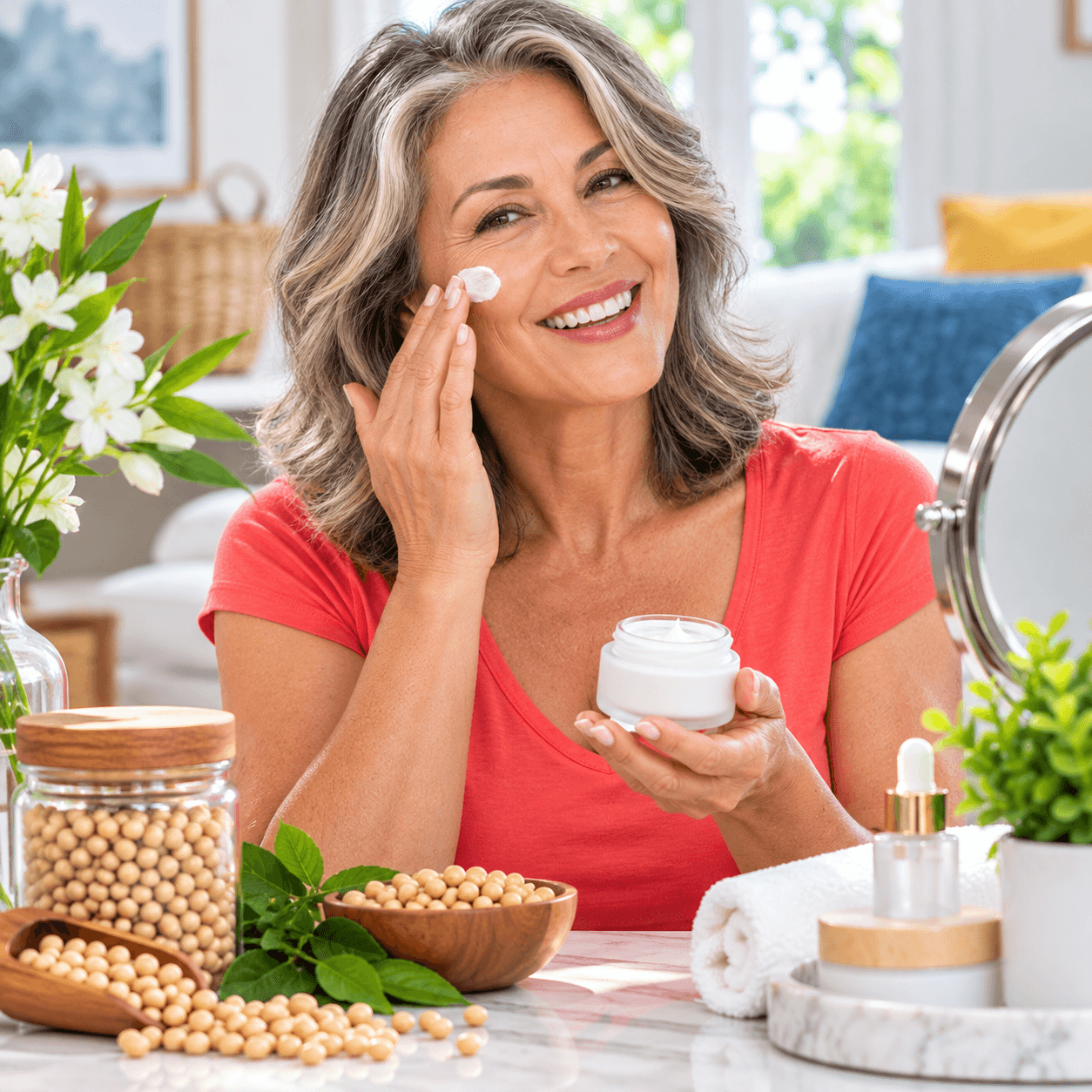
Phytoestrogen face creams are facial moisturizers made with plant-based ingredients, such as soy isoflavones. These ingredients can weakly connect with estrogen receptors in the skin. Small studies show they may reduce dryness and soften fine wrinkles, but results vary. They work slowly and are not as well proven as retinoids, sunscreen, and other dermatologist-recommended treatments for aging menopausal skin.
Phytoestrogen Face Creams And Wrinkles
Menopause can make familiar skincare suddenly feel inadequate. Skin may become drier, thinner, less plump, and more easily irritated as estrogen production falls.
Phytoestrogens are plant compounds with structures that resemble estradiol. Soy isoflavones, especially genistein and daidzein, are common examples. A phytoestrogen face cream for wrinkles delivers these ingredients directly to facial skin rather than through food or supplements.
Small clinical studies suggest that topical phytoestrogen may improve skin health and hydration, texture, epidermal thickness, and the appearance of fine lines and wrinkles. However, it should be viewed as supportive anti-aging skincare, not a facelift in a jar.
Estrogen Loss Changes Skin Structure

Estrogen receptors, particularly estrogen receptor beta, are present in keratinocytes, fibroblasts, sebaceous glands, and other skin cells. Estrogen helps regulate collagen production, elastin structure, hyaluronic acid, sebum, blood vessels, pigmentation, and wound healing.
During the first five years of menopause, women may lose up to 30% of dermal collagen. Research also estimates that skin collagen declines by about 2.1% and skin thickness by approximately 1.1% each year. These changes contribute to dryness, reduced skin elasticity, facial wrinkles, and slower repair (Rzepecki et al., 2019).
Declining progesterone accompanies this metabolic shift, but its independent role in skin aging is less clearly established. Sleep disruption, hot flashes, and nervous system regulation may also influence inflammation and barrier repair indirectly. Estrogen loss remains the better-supported hormonal driver of menopausal skin changes.
Topical Phytoestrogen Activates Receptors

Phytoestrogens bind more weakly to hormone receptors than estradiol or estriol. Genistein appears to favor estrogen receptor beta, which is widely distributed in human skin.
Laboratory evidence suggests that this interaction may support fibroblast activity, increase collagen synthesis, limit collagen breakdown, and promote hyaluronic acid production. These effects could plump the skin temporarily and improve skin firmness over time.
In studies of the facial skin of postmenopausal women, a 4% genistein gel used for 24 weeks increased epidermal thickness by 20% and dermal blood vessels by 77%. Hyaluronic acid also increased. Nevertheless, topical estrogen generally produced stronger results than genistein, and the trials were small (Rzepecki et al., 2019).
Face Cream Evidence Remains Limited
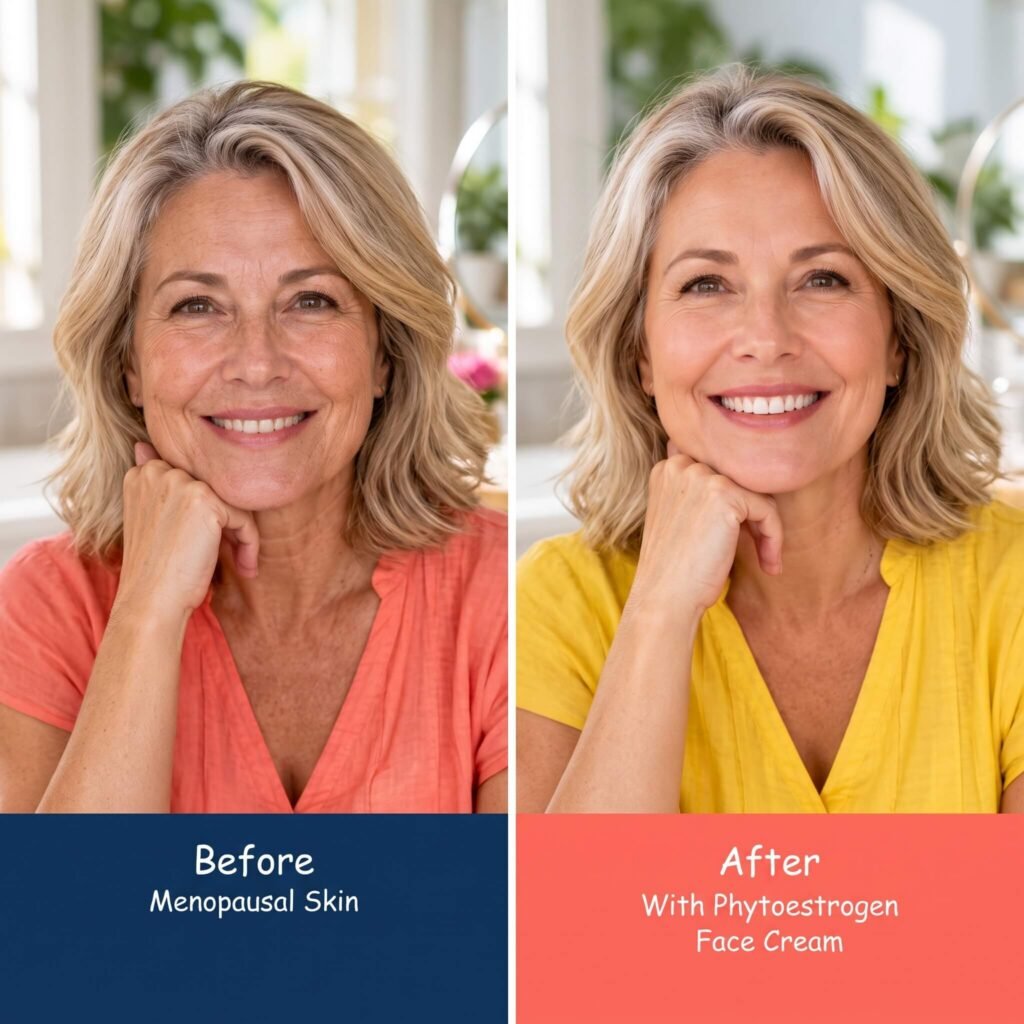
The effects of phytoestrogens are promising, but clinical studies do not yet prove that every cosmetic cream can reduce wrinkles. Ingredient concentration, formulation stability, penetration, study length, sun exposure, and baseline estrogen deficiency all affect results.
| Skin Care Option | Main Action | Best-Supported Benefits | Evidence Level | Key Limitation |
|---|---|---|---|---|
| 4% genistein gel | Weak estrogen receptor activity | Hydration, thickness, texture | Small human trials | Less effective than estrogen |
| Prescription topical estrogen | Direct estrogen receptor activation | Collagen, moisture, fine wrinkles | Several small trials | Hormonal and off-label concerns |
| Retinoid | Increases cell turnover and collagen | Photoaging, texture, wrinkles | Strong clinical evidence | Irritation and dryness |
| Hyaluronic acid moisturizer | Attracts and retains water | Immediate hydration and plumping | Good supportive evidence | Does not rebuild deep structure |
| Daily sunscreen | Reduces ultraviolet damage | Prevents wrinkles and uneven tone | Strong evidence | Preventive, not a lifting treatment |
Estrogen Cream Is Not Phytoestrogen
An estrogen cream contains an actual hormone, such as estriol or estradiol. A phytoestrogen cream contains plant-derived compounds that produce much weaker, more selective estrogen-like activity.
Prescription vaginal estrogen creams should not be repurposed as facial cream. They were formulated and approved for vaginal symptoms, not facial skin care. Using estrogen cream on the face may produce systemic absorption, and long-term facial safety data remain limited.
Systemic estrogen therapy should not be started solely to improve aging skin. Its benefits and risks require an individualized medical assessment.
Mature Skin Needs Complete Skincare
A phytoestrogen product cannot replace a complete skin care routine. For mature skin, broad-spectrum sunscreen, a gentle cleanser, a barrier-supporting face moisturizer, and an evidence-based active usually provide a stronger foundation.
Retinoids have better evidence for increasing collagen and reducing photoaging. Vitamin C may support antioxidant protection, while ceramides, glycerin, hyaluronic acid, and petrolatum help manage drier skin. Vitamin E can support a cosmetic formula, although it is not a proven stand-alone wrinkle treatment.
Emepelle Night Cream is marketed for estrogen-deficient skin and contains methyl estradiolpropanoate, or MEP, plus retinol and other skincare ingredients. MEP is described as non-hormonal, but it is not a soy phytoestrogen. A 20-week industry-sponsored study reported improvements in wrinkles, texture, hydration, and luminosity, but larger independent trials are needed (Cohen et al., 2019).
Anti-Aging Results Require Consistency
Use this practical protocol unless your dermatologist recommends otherwise:
- Patch-test the cosmetic cream for 48 hours.
- Apply a pea-sized amount to clean, dry skin once daily, following the label.
- Add a fragrance-free moisturizer containing ceramides, glycerin, or hyaluronic acid.
- Use broad-spectrum SPF 30 or higher every morning.
- Introduce retinol on two nonconsecutive nights weekly if tolerated. Do not layer it with a new active until your skin adjusts.
- Take baseline photographs in the same lighting.
- Reassess hydration after four weeks and fine lines after 12 to 24 weeks.
- Stop if burning, swelling, persistent redness, breast tenderness, or unexpected bleeding occurs.
A dermatologist can help separate estrogen loss from eczema, rosacea, sun damage, thyroid disease, or another cause of sudden skin changes.
Expert Angle: Track Barrier Recovery
A useful Wise Woman approach is to measure more than wrinkles. Track tightness after washing, moisturizer use, irritation, and makeup settling into fine lines.
This reflects an important evidence gap: the 2026 systematic review of topical estrogen treatments found potential benefits, but studies varied widely in formulas, treatment sites, and outcomes. For your Second Spring, improved comfort and barrier function may be a more realistic early success than dramatic lifting (Farkas et al., 2026).
Menopause Face Cream FAQs
Can Soy Isoflavones In Face Cream Mimic Estrogen?
Soy isoflavones can interact weakly with estrogen receptors in the skin. Clinical studies suggest possible improvements in hydration and skin structure, but their biological effect is much weaker than estradiol. They do not replace systemic estrogen or restore premenopausal estrogen levels.
Will Phytoestrogen Cream Cause Hormonal Effects?
Systemic absorption and long-term hormonal safety have not been studied adequately for every cosmetic cream. Phytoestrogens are weaker than prescription estrogen, but “plant-based” does not automatically mean risk-free. Stop use and seek medical advice if you experience unexpected hormonal symptoms.
How Long Until It Fixes Sagging Jowls?

A phytoestrogen cream may improve hydration and make skin look slightly plumper within several weeks. Studies assessing structural changes generally lasted about 12 to 24 weeks. It cannot reliably tighten significant jowls because facial sagging also involves fat, ligaments, muscle, and bone.
Is Phytoestrogen Better Than Retinol?
Retinoids have stronger evidence for treating fine lines, sun damage, and menopausal thinning. Phytoestrogen creams may be useful when dryness and estrogen-deficient skin changes are prominent, but direct comparison data are limited. Sensitive skin may require gradual retinol use or dermatologist-guided alternatives.
Is It Safe After Breast Cancer?
Anyone with breast cancer, especially hormone receptor-positive disease, should ask their oncologist before using estrogenic facial products. Safety findings for low-dose vaginal estrogen cannot automatically be applied to estrogen or phytoestrogen face cream. Consider established non-hormonal options first, including sunscreen, moisturizers, vitamin C, peptides, and clinician-approved retinoids.
Continue Your Journey
Learn more in our complete guide: How Do I Treat Menopause Dry Skin And The Loss Of Facial Elasticity?
References
- Rzepecki AK, Murase JE, Juran R, Fabi SG, McLellan BN. Estrogen-deficient skin: The role of topical therapy. International Journal of Women’s Dermatology. 2019;5(2):85-90. doi:10.1016/j.ijwd.2019.01.001.
- Silva LA, Carbonel AAF, de Moraes ARB, et al. Collagen concentration on the facial skin of postmenopausal women after topical treatment with estradiol and genistein: A randomized double-blind controlled trial. Gynecological Endocrinology. 2017;33(11):845-848. doi:10.1080/09513590.2017.1320708.
- Moraes AB, Haidar MA, Soares Júnior JM, et al. The effects of topical isoflavones on postmenopausal skin. European Journal of Obstetrics & Gynecology and Reproductive Biology. 2009;146(2):188-192. doi:10.1016/j.ejogrb.2009.04.007.
- Cohen JL, Jorizzo JL, Kircik LH. Evaluation of efficacy of a skin care regimen containing methyl estradiolpropanoate for treating estrogen-deficient skin. Journal of Drugs in Dermatology. 2019;18(12):1226-1230.
- Farkas E, et al. Topical estrogen for skin aging: A systematic review of efficacy and safety. Journal of the American Academy of Dermatology. 2026. doi:10.1016/j.jaad.2025.08.050.