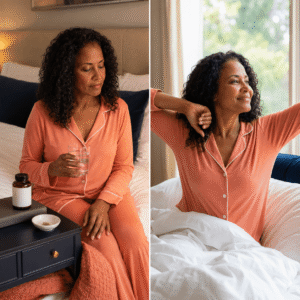
You finally wrap up a long day and crawl into bed. You just want a few hours of peaceful rest. Instead, you wake up at three in the morning roasting like a rotisserie chicken.
Marinating in your own pajamas while you are just trying to get some sleep is wildly exhausting. When you cannot cool down, your whole next day feels infinitely harder.
Finding real relief is entirely possible. We cannot fix every single perimenopause symptom overnight. We can, however, make tonight much more comfortable.
Before we change your bedroom setup, it helps to understand why you are sweating in the first place. You are not losing your mind. There is actual biology behind vasomotor symptoms like night sweats.
Your brain has a tiny control center called the hypothalamus. You can think of it as your body’s internal thermostat. During perimenopause, shifting estrogen levels confuse this thermostat.
Your brain suddenly thinks your core temperature is dangerously high. It triggers a massive cooling response to save you. Your blood vessels dilate, your heart races, and you start sweating profusely.
This is a normal bodily process reacting to mixed signals. We just need to give your body a supportive environment so that false alarm is less likely to trigger.
The One Surprising Tweak To Try Tonight
This brings us to the single most effective environmental change you can make. You need to lower your bedroom temperature much more than you probably think.
What To Try
Turn your bedroom thermostat down to a highly specific range. The optimal sleep temperature for adults is between 60 and 67 degrees Fahrenheit.
Why It May Help
To fall asleep and stay asleep, your core body temperature naturally needs to drop. According to the Sleep Foundation
, a cooler room actively supports this biological process.
When your external environment is cool, it acts as a gentle buffer against sudden hormonal heat spikes. Your confused internal thermostat is much less likely to panic and trigger a night sweat when the ambient air is already keeping your core comfortably chilled.
One Realistic Way To Practice This
Set an alarm on your phone for one hour before you plan to go to sleep. Use that reminder to walk over and drop the thermostat to 65 degrees. Letting the room cool down before you even pull back the covers signals your brain that it is time to rest.
How To Support Your New Cool Room
Lowering the thermostat is your main goal. If you share a bed or just want to maximize the cooling effect, you can add a simple layer to this strategy.
What To Try
Create targeted airflow right next to your side of the bed.
Why It May Help
A cool room is great, but moving air is even better. Airflow helps evaporate moisture from your skin quickly.
If a mild night sweat does happen, your body cools down and recovers much faster. You will not have to lie there feeling damp and frustrated in the dark.
One Realistic Way To Practice This
Place a small, quiet desk fan on your nightstand pointing directly at your upper body. Keep it on a low setting all night. If you wake up feeling a flash coming on, you already have instant relief blowing your way.
The Targeted Cool Down Trick
Sometimes you need a backup plan for those exceptionally stubborn hot flashes.
What To Try
Keep a source of immediate, targeted cold within arm’s reach of your pillow.
Why It May Help
Your pulse points are areas where your blood vessels are very close to the surface of your skin. Applying cold directly to your wrists or the back of your neck cools the blood quickly as it flows through your body. This rapid cooling can essentially short circuit a hot flash and calm your nervous system.
One Realistic Way To Practice This
Fill a small insulated thermos with ice water and leave it on your nightstand. If you wake up overheated, take a slow sip. You can also press a cool, damp washcloth against your wrists for thirty seconds to bring your core temperature down instantly.
Your Next Step For Better Rest
You deserve to wake up feeling refreshed and ready to handle your busy morning. Start with the easiest step first.
Adjust your thermostat tonight. See how a truly cool room transforms your rest.
Keep Exploring These Topics
- How Does Morning Sunlight Help Fix My Menopause Sleep Cycle?: Discover how morning sunlight may support your menopause sleep cycle by helping regulate your body clock and encouraging more restful nights.
- How To Use Cognitive Shuffling To Fall Back Asleep After A Menopause Night Waking: Waking up during menopause and struggling to drift off again? Discover how cognitive shuffling may quiet racing thoughts and help you ease back to sleep.
Coming Up Next
If you have been struggling to get through the afternoon without feeling completely drained, there is a very good reason for it. The connection between your night sweats and your daily energy levels is incredibly real.
In our next email, we are going to explore exactly why you feel so exhausted right now. We will look at how interrupted sleep cycles create daytime brain fog and share practical ways to protect your energy. Keep an eye on your inbox so you do not miss it.