

The 60-Second Answer
Yes, hyaluronic acid suppositories can improve vaginal dryness, irritation, and painful intercourse, sometimes comparably to local estrogen. However, research on hyaluronic acid vs estrogen cream for atrophy remains limited. Estrogen generally produces stronger changes in vaginal pH and cell maturation, while hyaluronic acid offers a useful non-hormonal option.
Hyaluronic Acid Vs Estrogen Cream
Declining estrogen levels reduce activation of hormone receptors in vaginal epithelial cells. This lowers blood flow, collagen support, lubrication, glycogen, and lactobacilli. The vaginal mucosa becomes thinner, less elastic, and more vulnerable to dryness and pain. Vaginal pH rises, which may also increase susceptibility to irritation and vaginal infection.
Progesterone decline is not considered the main driver of vaginal atrophy, although broader hormonal changes can affect nervous system regulation, sexual arousal, sleep, and pain sensitivity.
Hyaluronic acid is a natural water-binding molecule. A suppository, vaginal gel, or vaginal moisturizer containing hyaluronic acid draws water into the extracellular matrix and forms a hydrating film over vulvar and vaginal tissue. It does not directly reactivate estrogen receptors.
Vaginal estrogen works differently. Low-dose vaginal estrogen binds local hormone receptors, increases vaginal epithelial cells, improves vaginal cell maturation, restores glycogen, and helps lower vaginal pH. This biological restoration explains why estrogen cream may outperform moisturizers for objective markers, even when both relieve symptoms.
Hyaluronic Acid Improves Vaginal Dryness
Clinical trials suggest that hyaluronic acid for vaginal dryness can reduce burning, dryness, itching, and dyspareunia. In a multicenter trial of 144 postmenopausal women, symptom improvement after 30 days reached 84.4% with hyaluronic acid vaginal gel and 89.4% with estriol cream, without a statistically significant difference between groups. Estriol produced a lower vaginal pH, indicating a stronger biological estrogen effect (Chen et al., 2013).
A 2024 randomized pilot trial compared a hyaluronic acid suppository with vaginal estrogen cream for 12 weeks. Both groups experienced substantial improvements in genitourinary syndrome of menopause symptoms, and more than 90% achieved a clinically meaningful improvement. Because only 49 women completed the study, it was not designed to prove that hyaluronic acid was definitively non-inferior to estrogen (Agrawal et al., 2024).
Estrogen Restores Vaginal Tissue

Topical estrogen is the more established treatment for vaginal atrophy in postmenopausal women. It treats both symptoms of vaginal dryness and underlying estrogen-responsive tissue changes.
Current professional guidance recommends low-dose vaginal estrogen for vulvovaginal dryness, irritation, and dyspareunia. Vaginal estrogen therapy may also help reduce recurrent urinary tract infections, an outcome that has not been established for hyaluronic acid products (AUA/SUFU/AUGS Guideline).
HA And Estrogen Show Key Differences

| Treatment | Primary Action | Symptom Relief | Tissue And pH Effects | Hormone Exposure |
|---|---|---|---|---|
| HA suppository or gel | Retains water and coats tissue | Moderate to substantial | Limited evidence of cell maturation | None |
| Estrogen cream | Activates local estrogen receptors | Substantial | Improves vaginal maturation index and pH | Low local exposure |
| Standard vaginal moisturizer | Provides ongoing hydration | Best for mild vaginal dryness | Does not reverse estrogen deficiency | None |
| Personal lubricant | Reduces friction during sex | Immediate, short-lived | No tissue restoration | None |
| Vaginal DHEA | Converts locally into sex steroids | Improves dryness and pain | Supports epithelial tissue | Hormonal prescription |
A systematic review found that hyaluronic acid may have efficacy, safety, and tolerability similar to vaginal estrogen in some studies, but the trials were small and varied considerably in formulation and measurement methods (Dos Santos et al., 2021). Another systematic review found that three trials reported no significant difference, while one favored estrogen and one higher-risk study favored hyaluronic acid (Saghafi et al., 2019).
Use Hyaluronic Acid Consistently
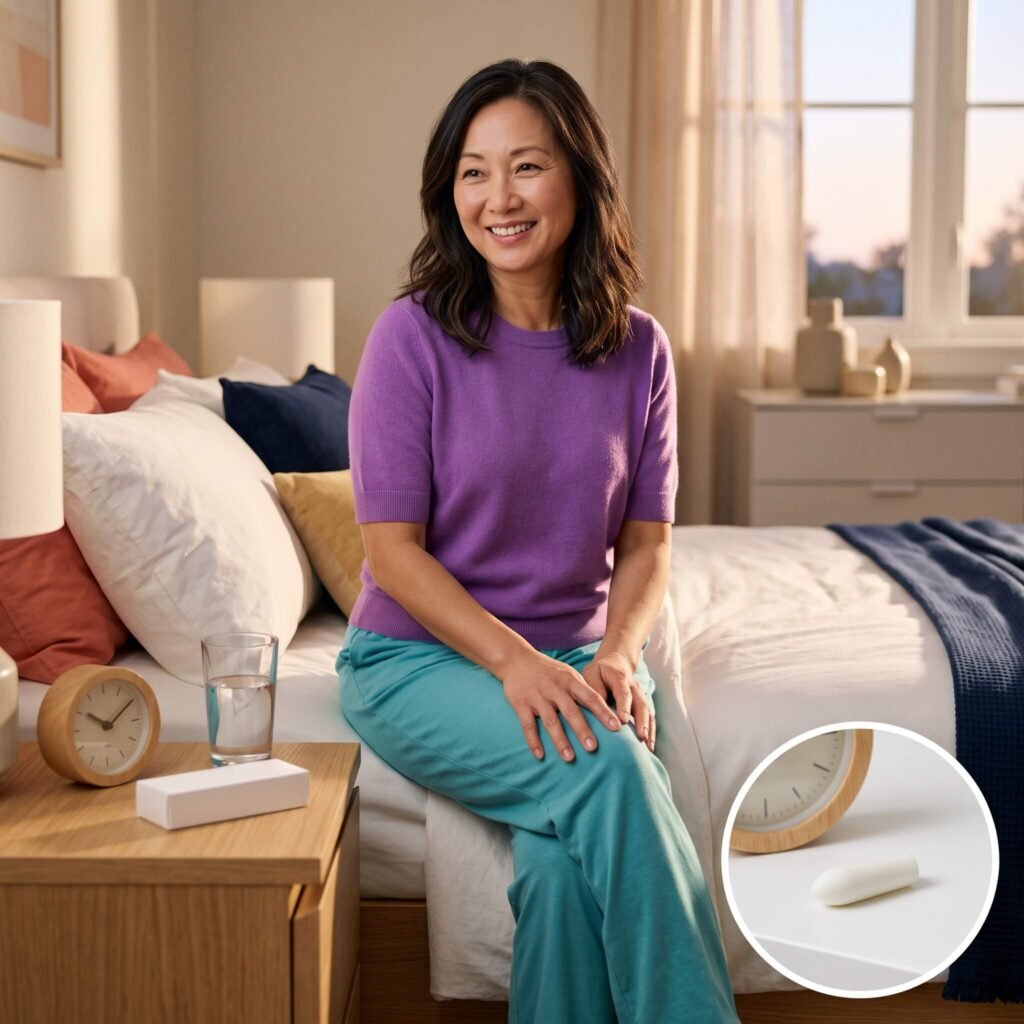
A practical treatment with hyaluronic acid should follow the specific product instructions:
- Choose a vaginal insert or vaginal gel specifically formulated for internal use. Avoid cosmetic skin serums.
- Insert the product at bedtime. Research regimens have ranged from every three days for 30 days to nightly loading followed by maintenance use.
- Continue for 8 to 12 weeks before judging the full response, unless irritation develops.
- Use vaginal lubricant during intercourse because moisturizers and lubricants serve different purposes.
- Track dryness, burning, pain during penetration, urinary symptoms, bleeding, and product reactions weekly.
- If improvement is inadequate, ask about pelvic floor physical therapy, low-dose vaginal estrogen, vaginal DHEA, or ospemifene.
Do not assume that a higher hyaluronic acid concentration is better. Formulation, vaginal retention, osmolality, and dosing frequency may influence results more than the advertised percentage.
Vaginal Bleeding Requires Evaluation

Seek medical care for postmenopausal vaginal bleeding, bleeding after intercourse, unusual discharge, odor, sores, severe pelvic pain, or persistent symptoms. These can reflect infection, dermatologic disease, pelvic floor dysfunction, medication effects, or malignancy rather than uncomplicated vaginal atrophy.
A Wise Woman approach treats persistent dryness as a health issue, not something you are expected to tolerate.
HA Products Need Better Comparison

The strongest information-gain opportunity is product-specific research. Future trials should identify each suppository’s molecular weight, concentration, pH, osmolality, dissolution time, and retention rather than treating every hyaluronic acid-based vaginal product as interchangeable.
Researchers should also separate subjective comfort from objective outcomes such as vaginal pH, vaginal maturation index, epithelial thickness, recurrent infections, and painful intercourse. This would clarify when hyaluronic acid is truly comparable to estrogen and when it primarily functions as a vaginal moisturizer.
Frequently Asked Questions
Are HA Suppositories Safe After Cancer?

Hyaluronic acid suppositories are generally considered a reasonable non-hormonal treatment for breast cancer survivors experiencing vaginal dryness. Individual products may contain additional ingredients that cause irritation. Survivors should involve their oncologist or gynecologist, especially when symptoms follow cancer treatment.
How Fast Can HA Heal Vaginal Lining?
Some women notice improved moisture within days, but trials generally assess treatment after 4 to 12 weeks. Hyaluronic acid may hydrate and support tissue repair, but it does not restore estrogen receptor activity. Persistent vaginal dryness and soreness should be reassessed.
Are HA Vaginal Inserts Prescription Only?
Many hyaluronic acid vaginal inserts and gels are available without a prescription, depending on the country. Product quality, dosage, and application schedules are not standardized. Select a product designed specifically for vaginal use and follow its instructions.
Can HA Reverse Vaginal Wall Thinning?
Hyaluronic acid may improve hydration, elasticity, dryness, and discomfort. Evidence that it reverses thinning as effectively as low-dose vaginal estrogen is less certain. Estrogen has stronger evidence for improving vaginal cell maturation and acidic pH.
Continue Your Journey
Explore this guide: How do I manage painful intercourse and vaginal atrophy without hormones? to compare moisturizers, lubricants, pelvic floor therapy, dilators, and other non-hormonal strategies.
References
- Agrawal S, et al. “A Randomized, Pilot Trial Comparing Vaginal Hyaluronic Acid to Vaginal Estrogen for the Treatment of Genitourinary Syndrome of Menopause.” Menopause. 2024;31(9):750-755. doi:10.1097/GME.0000000000002390.
- Chen J, et al. “Evaluation of the Efficacy and Safety of Hyaluronic Acid Vaginal Gel to Ease Vaginal Dryness.” Journal of Sexual Medicine. 2013;10(6):1575-1584. doi:10.1111/jsm.12125.
- Dos Santos CCM, et al. “Hyaluronic Acid in Postmenopause Vaginal Atrophy: A Systematic Review.” Journal of Sexual Medicine. 2021;18(1):156-166. doi:10.1016/j.jsxm.2020.10.016.
- Saghafi N, et al. “Comparison of the Effect of Hyaluronic Acid and Estrogen on Atrophic Vaginitis: A Systematic Review.” International Urogynecology Journal. 2019;30:1599-1608. doi:10.1177/2053369119830818.
- American Urological Association, SUFU, and AUGS. “Genitourinary Syndrome of Menopause Guideline.” 2025.
- American College of Obstetricians and Gynecologists. “Treatment of Urogenital Symptoms in Individuals With a History of Estrogen-Dependent Breast Cancer.” Clinical Consensus. 2021.